.png)
Why is Germany considered the Powerhouse of Europe?

Why is the Federal Republic of Germany often called the Powerhouse of Europe? What makes a post-war nation, once divided, rise to become one of the world's most powerful economies, military, diplomatic, and technological forces? Let’s find out with Eurostellar in the following article.

THE FEDERAL REPUBLIC OF GERMANY
Germany (German: Deutschland), officially the Federal Republic of Germany (German: Bundesrepublik Deutschland), is an independent sovereign state in Central Europe. It is a federal parliamentary republic consisting of 16 states.

Key Highlights:
Germany has a total area of 357,022 km² and a seasonal climate, mostly temperate.
The population is approximately over 83 million, the second most populous in Europe (after Russia), and 19th in the world.
Germany has the second-highest number of immigrants in the world, just behind the United States (according to 2014 data).
The capital and largest metropolis is Berlin.
The country comprises 16 states. Major cities include: Hamburg, München, Köln, Frankfurt, Stuttgart và Düsseldorf.
Various Germanic tribes inhabited northern Germany since classical antiquity. A region named Germania was documented before AD 100. During the migration period, Germanic tribes expanded southward. Beginning in the 10th century, German territories formed a central part of the Holy Roman Empire. In the 16th century, northern German regions became the center of the Protestant Reformation. The international name GERMANY also originated from there.

In 1871, Germany became a nation-state when most German states unified (excluding Austria) into the German Empire dominated by Prussia. After World War I and the German Revolution of 1918-1919, the Empire was replaced by the Weimar Republic under a parliamentary system. The Nazi military dictatorship was formed in 1933, leading to World War II and a genocide until 1945.
After a period of Allied occupation, two German states were founded in the West and East during the Cold War: the Federal Republic of Germany and the German Democratic Republic (1949). In 1989, the Berlin Wall fell during a peaceful revolution against the East German state. In 1990, Germany was reunified after more than 45 years of division.

JOURNEY TO BECOMING THE POWERHOUSE OF EUROPE
Since reunification, Germany has maintained its position as a Great Power and has the 4th largest economy in the world by nominal GDP, and the 5th largest globally by purchasing power parity (PPP). Germany leads the world in heavy industry and high technology sectors and was the world's 3rd largest exporter and importer (2015). Germany is a developed country with a very high standard of living maintained by a skilled and productive society. The nation maintains a comprehensive social security and universal health care system, environmental protection, and tuition-free university education.
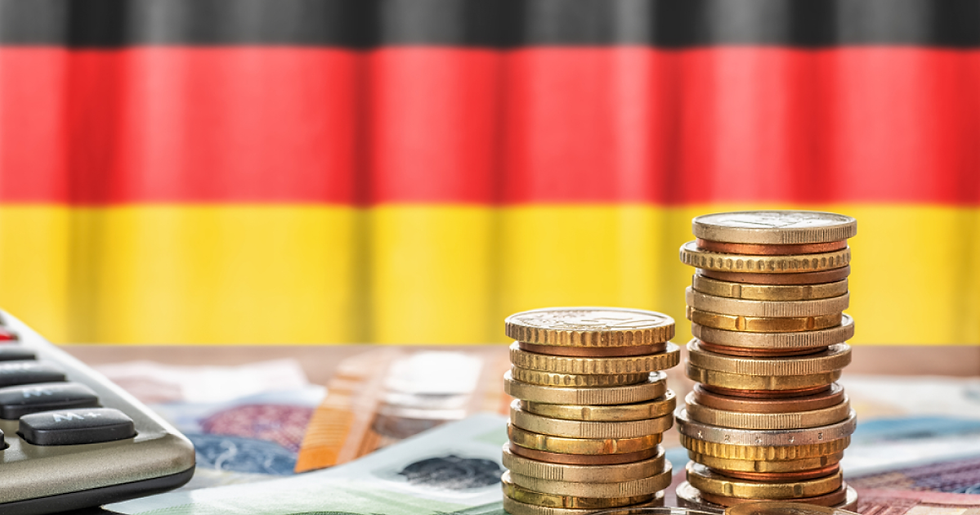
Germany was a founding member of the European Union in 1993, is part of the Schengen Area, and became a co-founder of the Eurozone in 1999. Germany is a member of the United Nations, NATO, G8, G7, G20, the Paris Club, and the OECD. Its national military expenditure is the 9th highest in the world. Germany has a rich cultural history, continuously producing influential figures in art, philosophy, music, sports, entertainment, science, engineering, and invention.

Germany has a social market economy, with a highly skilled labor force, large capital stock, low levels of corruption, and a high level of innovation. It is the third-largest exporter of goods in the world and has the largest national economy in Europe.
The service sector contributes approximately 71% to total GDP (including information technology), industry 28%, and agriculture 1%. The unemployment rate published by Eurostat was 4.7% in January 2015, the lowest among all 28 European Union member states. At 7.1%, Germany also had the lowest youth unemployment rate in the EU. According to the OECD, Germany is among the countries with the highest labor productivity in the world.

Germany is located within the European Single Market, corresponding to over 500 million consumers. Certain domestic commercial policies are determined by agreements among EU members and by EU legislation. Germany introduced the common European currency, the Euro, in 2002. Germany is part of the Eurozone, representing about 338 million citizens. Monetary policy is set by the European Central Bank headquartered in Frankfurt, which is the financial center of continental Europe.

HOMELAND OF THE MODERN AUTOMOBILE
Germany is the birthplace of the modern automobile. The automotive industry in Germany is regarded as one of the most competitive and innovative in the world and ranks fourth in production output.
The ten largest export items of Germany are vehicles, machinery, chemicals, electronic products, electrical equipment, pharmaceuticals, transport equipment, base metals, food products, rubber, and plastics.

Among the world's 500 largest stock-market-listed companies by revenue in 2014 (Fortune Global 500), 28 are headquartered in Germany. 30 Germany-based companies are listed in the DAX, the German stock market index. Internationally renowned brands include Mercedes-Benz, BMW, SAP, Volkswagen, Audi, Siemens, Allianz, Adidas, Porsche, and DHL.

Germany has a large sector of specialized small and medium-sized enterprises (SMEs), known as the Mittelstand model. About 1,000 of these are global market leaders in their segments and are labeled as "hidden champions." Berlin has developed into a thriving, global hub for startups and has become a leading location for venture capital firms in the European Union.
Thank you for reading this article. To learn more about German and European technology, please contact Eurostellar.


Comments